Most of your customers will never walk your production floor. The category buyer at a national grocer, the brand owner considering you as a co-packer, the importer on the other side of the world: many of them form their opinion of your business through a screen.
That makes your meeting room one of the most important sales tools in the building. A dropped call, a muffled voice or a blurry product shot can undo months of relationship building. A clean, confident presentation tells a buyer you run a tight operation.
Here is how Canadian food manufacturers use AV systems to support client-facing meetings, product development reviews and audits, and what to look for when you plan a space.
A Concentrated Market Raises the Stakes on Every Meeting
Canadian grocery retail is highly concentrated. The Competition Bureau’s 2023 retail grocery market study found that just five large grocery chains operate in Canada: Loblaw, Sobeys, Metro, Costco and Walmart. The three largest reported more than $100 billion in combined sales in 2022. Sure, there are smaller chains like No Frills, Freshco, and Food Basics, but they don’t have the volume of the big 5.
For suppliers, that means a relatively small number of buying teams control access to most of the shelf. Every meeting with one of them carries real weight.
The relationship itself is becoming more structured. The Canada Grocery Code took full effect on January 1, 2026. All five major grocers registered with the Office of the Grocery Sector Code of Conduct, along with more than 150 other retailers and suppliers.
With more attention on transparency and predictability between retailers and suppliers, clear and professional communication matters more than ever.
Meanwhile, most processors are small businesses. Agriculture and Agri-Food Canada (AAFC) reports that 95% of food and beverage processing establishments had fewer than 100 employees in 2022. A well equipped meeting room helps a smaller processor present with the same polish as a much larger competitor.
Export Growth Means More Meetings Across Time Zones
Canadian processors are selling further afield than ever. According to AAFC, exports of processed food and beverage products reached a record $59.8 billion in 2024. That was up 3.8% from 2023 and equal to 34.5% of production value, with products going to almost 200 countries.
Many of those buyers meet suppliers on video first, and some never visit in person at all.
A meeting room that connects reliably, sounds natural and works with whichever platform the buyer prefers removes friction from those conversations, whatever the time zone.
Four Client-Facing Spaces Where AV Makes a Difference
1. The buyer meeting room
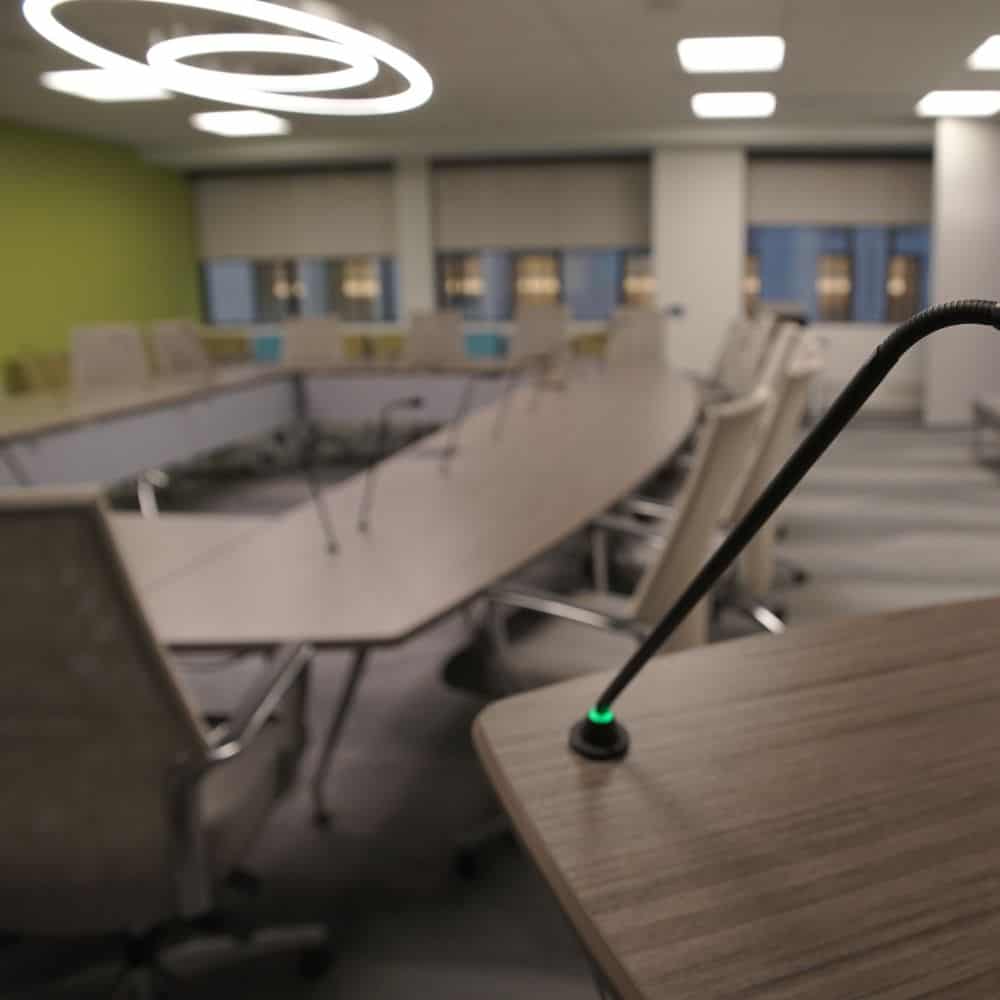
This is where pitches, line reviews and contract discussions happen. The basics matter most: a camera that frames everyone at the table, microphones that capture every voice without anyone raising theirs, and a display large enough for your team to see the remote party and your content clearly.
Platform flexibility is just as important. One retailer may run on Microsoft Teams, another on Zoom, an export partner on something else entirely. A room that lets your team join any platform without hunting for cables keeps the focus on your products.
2. The R&D kitchen or sensory lab
Product development is increasingly collaborative. Brand owners and retail private label teams want to see formulations, textures and packaging before they approve a run.
An overhead camera above the prep counter, a second camera for close-ups and good microphone coverage let a remote customer follow a demonstration as if they were standing at the bench.
Lighting matters here. The CFIA’s establishment guidance notes that where food colour is assessed, lighting should not alter the natural colour of the food. The same principle applies on camera. Colour-accurate lighting and properly configured cameras help your customer see the product as it really is.
3. Virtual plant walkthroughs
Food plants cannot open their doors to every visitor. The Safe Food for Canadians Regulations expect the movement of people into and within a facility to be controlled, and the CFIA gives accounting for all visitors and contractors as an example. Allergen zones, hygiene protocols and biosecurity add further limits.
A virtual walkthrough lets a prospective customer see your lines, your controls and your people without gowning up or adding traffic to the floor.
It takes planning. Food Safety Magazine has noted that connectivity problems can disrupt livestreamed walkthroughs, especially inside insulated areas such as coolers and freezers. Reliable wireless coverage, a stable camera kit and a wireless microphone that cuts through equipment noise make the difference between an impressive tour and a frustrating one.
4. The audit room
Remote and blended audits are now part of the certification landscape. In June 2020, GFSI began allowing information and communication technology (ICT) in benchmarked certification audits, as long as remote activities are mutually agreed and meet full audit objectives.
Each certification program sets its own rules. Food Safety Magazine reported that SQF’s policy allows remote activities to account for up to 50% of audit duration. BRCGS offers a blended audit, in which a remote assessment is followed by an onsite audit.
Remote portions usually cover document review and interviews with management. That calls for a room where auditors can clearly see shared documents, hear every participant and, when needed, view live video from the floor. The same room works well when customers run supplier reviews remotely.
Remote options are agreed with your certification body case by case and are never guaranteed. Having a room that is ready simply means you can say yes when the option is offered.
Want a meeting room that is ready for buyers, product reviews and auditors? Century Audio Visual Ltd. provides AV system design, sales and service across the GTA and Southern Ontario. Book a consultation with Century AV
Design Considerations for Client-Facing Rooms
A few principles separate rooms that impress from rooms that embarrass:
- Audio first. Remote participants will forgive a slightly soft image. They will not forgive missing words.
- One-touch start. Your sales lead should be able to launch a meeting in seconds, without IT on standby.
- Any platform. Support the platforms your customers use, not only the one your company prefers.
- Easy content sharing. Wireless presentation lets a food scientist share a spec sheet or a product photo from a phone without delay.
- Protect what is confidential. Formulations, supplier pricing and unreleased packaging should never wander into a camera’s view. Plan camera angles, whiteboard placement and glass wall treatments with that in mind.
- Plan for service. A failed display on the morning of a line review is a sales problem, not just an IT ticket.
Your Meeting Room Is Part of Your Pitch
Canada’s food manufacturers compete for a limited number of major retail buyers, for co-pack contracts and for export customers around the world. Many of those decisions are shaped in meetings where the customer never tastes the product in person or walks the floor.
Investing in the rooms where those meetings happen is investing in how your business is perceived. Clear audio, strong video and simple controls let your people and your products do the talking.
For 30 years, Century Audio Visual Ltd. has designed, installed and supported commercial AV systems for Ontario organizations. Contact us to plan a buyer meeting room, an R&D camera system or an audit-ready conference space, backed by ongoing service. Contact Century AV
Sources
1. Competition Bureau retail grocery market study, as reported by Canada’s National Observer, Too many giants control Canada’s grocery business. https://nationalobserver.com/2023/06/27/news/giants-control-canada-grocery-business-competition-bureau
2. Canadian Grocer, The Canada Grocery Code takes effect. https://canadiangrocer.com/canada-grocery-code-takes-effect
3. Agriculture and Agri-Food Canada, Overview of the food and beverage processing industry. https://agriculture.canada.ca/en/node/732
4. Agriculture and Agri-Food Canada, Overview of the agriculture and agri-food sector: deputy minister transition book 2024. https://agriculture.canada.ca/en/department/transparency/briefing-documents/aafc-transition-books/overview-agriculture-and-agri-food-sector-deputy-minister-transition-book-2024-aafc
5. Canadian Food Inspection Agency, Regulatory requirements: Preventive controls for food businesses. https://inspection.canada.ca/en/food-safety-industry/preventive-control-plans/regulatory-requirements
6. Food Safety Magazine, Inspiration and innovation out of crisis: the value of virtual auditing. https://food-safety.com/articles/6778-inspiration-and-innovation-out-of-crisisthe-value-of-virtual-auditing
7. Food Safety Magazine, Best practices for remote food audits. https://food-safety.com/articles/7136-best-practices-for-remote-food-audits
8. BRCGS 080, Position statement and procedure for blended audits: remote auditing using ICT. https://info.aibinternational.com/hubfs/GFSI%20Forms/BRCGS080.pdf?hsLang=en