If you run a food plant in Canada, training never really stops. A new hire starts on Monday. A line changes over for an allergen-free run. A sanitation procedure gets revised after an internal audit. Each of those moments depends on people knowing exactly what to do, and on you being able to show they were taught.
That is where your audio visual systems earn their place. The display in your training room, the audio on your production floor, and the video conferencing that links your sites are more than conveniences. Designed well, they become part of how you deliver training that is consistent, repeatable and documented.
Here is how Canadian food manufacturers can use AV to support training programs that hold up to scrutiny, and what to think about before you invest.
Canada’s Largest Manufacturer Carries a Heavy Training Load
Food and beverage processing is the largest manufacturing industry in Canada. In 2024 it recorded $173.4 billion in sales of goods manufactured, 20.3% of all manufacturing sales, and employed 318,400 Canadians, according to Agriculture and Agri-Food Canada (AAFC).
It is also an industry of smaller operators. AAFC reports that 95% of food and beverage processing establishments had fewer than 100 employees in 2022.
Smaller plants rarely have a dedicated training department, yet they answer to the same regulators and auditors as the largest processors. Food Processing Skills Canada (FPSC) has found that 40% of businesses in the sector lack a dedicated HR department or HR staff.
When training falls to supervisors who are also running a line, anything that makes training easier to deliver the same way every time deserves a close look.
What the SFCR Expects From Your People
The Safe Food for Canadians Regulations (SFCR) set out preventive control requirements for businesses licensed to manufacture, process, package or label food. Competency is one of them. Section 75 requires that employees involved in those activities have the competencies and qualifications needed to carry out their duties.
Hygiene requirements sit right beside it in the regulations, covering how employees conduct themselves in food handling areas.
Falling short is costly. The Canadian Food Inspection Agency (CFIA) warns that failing to meet federal requirements can lead to product seizure or recall, licence suspension or cancellation, and administrative penalties or prosecution.
If your plant holds a GFSI-benchmarked certification such as SQF or BRCGS, there is a second layer. Third-party auditors review training records, and they often speak with employees on the floor to confirm procedures are understood.
To be clear, AV equipment does not make a plant compliant on its own. What it can do is help you deliver approved training consistently and leave a clear trail showing that training took place.
The Workforce Picture Makes Consistency Harder
The labour challenge adds pressure. FPSC projects that the Canadian food and beverage manufacturing industry will need 142,000 new people between 2023 and 2030. That total includes 66,870 expected retirements and roughly 50,000 vacancies that were already unfilled.
Every one of those new hires needs GMP, allergen, sanitation and hygiene training before they handle product. Every retirement takes years of experience out the door, much of it never written down.
Vacancies carry a direct cost too. FPSC research estimates that a single unfilled position can cost a business up to $190 per day in lost net revenue. Getting new people trained and productive sooner has real, measurable value.
The workforce is also diverse. Immigrants make up 31% of the industry’s workforce, according to FPSC, a few points higher than the general Canadian labour force. Many plants run multilingual crews across rotating shifts, with a mix of permanent, temporary and agency staff.
In that setting, a session delivered one way on day shift and another way on nights can drift apart quickly. Visual, recorded and repeatable training helps close that gap.
Five Ways AV Supports Audit-Ready Training
1. A training room people actually want to use
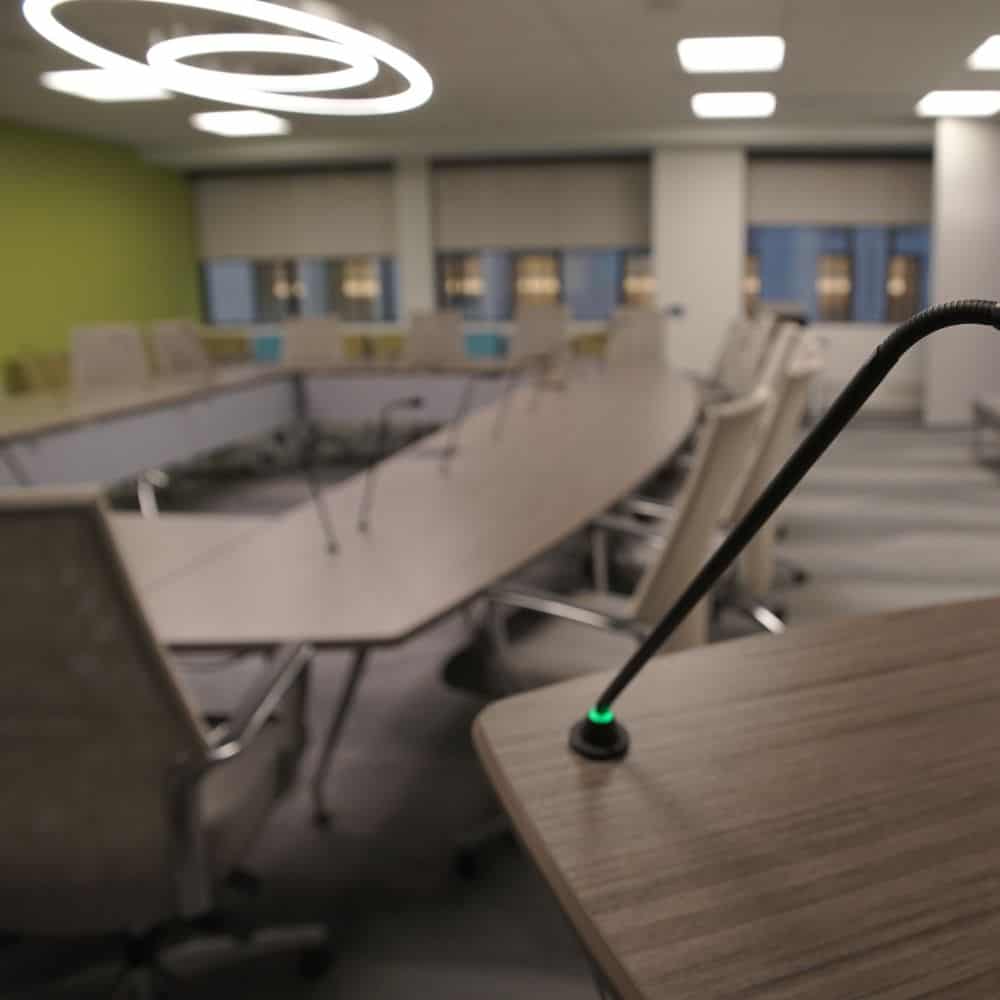
A good training room has a display large enough to read from the back row, clear audio without echo bouncing off hard walls, and simple controls that let any supervisor start a session without calling IT.
When the room is easy to use, recorded modules get used. When it is frustrating, people fall back on photocopies and verbal walk-throughs, and consistency suffers.
2. Recorded sessions that lock in the approved method
Recording a qualified trainer demonstrating a sanitation procedure, a metal detector check or an allergen changeover means every new employee sees the same approved method.
When a procedure changes, you update the recording and retire the old version. Paired with sign-in sheets or learning management system completions, recordings also give you something concrete to show an auditor.
3. Captions and visual demonstration for multilingual teams
Many current conferencing and presentation platforms offer live captions, and some offer translated captions. Combined with clear visual demonstration, this helps employees whose first language is not English or French follow along.
Video of a task being done correctly often communicates across language barriers better than a written SOP ever will.
4. Digital signage at the point of work
Screens in lunchrooms, change rooms and near the entrances to production areas can reinforce hand washing, PPE rules, allergen reminders and recent audit findings. The CFIA’s own guidance lists hand-washing notices posted at entrances to food production areas as an example of meeting hygiene requirements.
Digital signage lets you update those messages across every screen in minutes, and schedule different content by shift or department.
Any display near food areas should be selected with your sanitation program in mind, including where it is mounted, how it is cleaned and how it is protected against breakage.
5. Conferencing that connects sites, shifts and experts
Multi-site processors can run one session for several plants at once. A corporate QA lead can deliver a refresher to night shift without a long drive. An equipment vendor can walk your maintenance team through a new line remotely.
For this to work, the room needs cameras that frame everyone at the table, microphones that pick up questions from the back, and a display that shows the remote presenter and shared content together.
Planning a training room or a plant communication upgrade? Century Audio Visual Ltd. designs, supplies and services commercial AV systems across the GTA and Southern Ontario. Book a consultation with Century AV
Communication Beyond the Training Room
Training does not end when the session does. Shift huddles, safety alerts and changeover notices all depend on getting the right message to the right people at the right moment.
On a loud production floor, overhead audio has to be intelligible over compressors, conveyors and fillers. Zoned paging lets you reach the sanitation crew without interrupting packaging. Visual alerts on displays can back up audio messages in areas where hearing protection is required.
Huddle boards shown on large displays keep KPIs, food safety reminders and the day’s priorities in front of every crew, not only the one that attended the morning meeting.
Planning Tips Before You Invest
Start with the training program, not the equipment. A few questions will shape a far better system:
- Which modules must be delivered, how often, to whom and in which languages?
- Which spaces are involved: training room, lunchroom, production floor, boardroom?
- What conditions will equipment face, such as humidity, washdown, temperature swings and noise?
- How will recordings and attendance records be stored so they can be found quickly during an audit?
- Can a busy supervisor run the room with one touch?
- Who will service the system when a display fails the week before an audit?
Answering these first keeps your budget focused on the spaces and features that matter most to your food safety program.
Make Training the Easiest Part of Your Next Audit
Canadian food manufacturers are hiring at pace, training across languages and shifts, and answering to both the CFIA and third-party auditors. The plants that handle this well tend to treat training delivery as infrastructure, not an afterthought.
The right AV systems will not write your SOPs or run your preventive control plan. They will make it easier to deliver the right training, the same way, to every employee, and to prove it when someone asks.
Century Audio Visual Ltd. has spent 30 years designing, installing and supporting AV systems for Ontario organizations. If you are planning a training room, digital signage or a plant-wide communication project, contact our team for system design, sales and service. Contact Century AV
Sources
1. Agriculture and Agri-Food Canada, Overview of the food and beverage processing industry. https://agriculture.canada.ca/en/node/732
2. Agriculture and Agri-Food Canada, Overview of the agriculture and agri-food sector: deputy minister transition book 2024. https://agriculture.canada.ca/en/department/transparency/briefing-documents/aafc-transition-books/overview-agriculture-and-agri-food-sector-deputy-minister-transition-book-2024-aafc
3. Food in Canada (Food Processing Skills Canada), Success factors when hiring newcomers. https://foodincanada.com/features/success-factors-when-hiring-newcomers
4. Food in Canada, October 2023 (Jennefer Griffith, Food Processing Skills Canada), Industry needs 142k new employees. https://digitaledition.mydigitalpublication.com/article/Industry+needs+142k+new+employees/4651683/803796/article.html
5. Canadian Food Inspection Agency, Regulatory requirements: Preventive controls for food businesses. https://inspection.canada.ca/en/food-safety-industry/preventive-control-plans/regulatory-requirements
6. Canadian Food Inspection Agency, Checklist for preventive controls. https://inspection.canada.ca/en/food-safety-industry/opening-expanding-food-business/preventive-control-checklist